In Mexico, haute couture isn't merely a technique; it's a dance between threads and emotions, a...
There are eras we don't just remember; we feel them. Like the golden age of Mexican cinema, where every glance and every fold of fabric told a grander story. In each frame, the identity of a nation learning to see itself with elegance and strength was being embroidered.
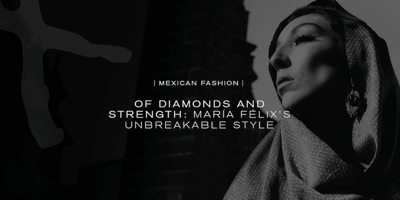
María Félix, Dolores del Río, Sara García, and Esther Fernández were modern goddesses draped in silk, sequins, and lace. Through them, fashion ceased to be an accessory and became an act of resistance, art, and power.
Read on and discover how this era influenced the greatest runways.
Mexican cinema and fashion: a visceral union
In Mexico, fashion didn't follow cinema; it was born with it. It was a narrative ally. The attire and gowns of Mexican cinema's golden age were script, atmosphere, and character.
In the films of the Golden Age, embroidered blouses, silk rebozos, demure necklines, and fitted skirts weren't simply styling choices: they were symbols, whispers of an identity being built.
The leading ladies didn't dress to please but to command. Each garment was a declaration. And thus, cinema embroidered an aesthetic that still lives on our runways.
Iconic wardrobe: films that dressed a nation
Some films became eternal for their narrative, others for their visual power, embodying the soul of the authentic Mexico City of that time.
And here, what became immortal was the wardrobe:
Salón México (1949)
Directed by Emilio Fernández, this film turned the wardrobe into emotional testimony.
The character of Mercedes (Marga López) wears structured necklines and tailored skirts that speak for her when her words are stifled. Fabric becomes a mask, but also truth.
A tragic, silent glamour that continues to influence contemporary fashion.
Allá en el Rancho Grande (1936)
This comedy transformed into an aesthetic manifesto.
Blouses with floral embroidery, perfectly fitted charro suits, zarapes that fall like royal capes over shoulders: everything spoke of a Mexico proud of its roots.
Jorge Negrete, with his impeccable bearing, redefined masculine elegance with an embroidered jacket and a wide-brimmed hat.
La diosa arrodillada (1947)
María Félix, immortalized in this film, didn't wear costumes: she wore velvet armor, empire-waist gowns, asymmetrical necklines that traced power in every curve.
No fabric was without intention.
Luxury wasn't ostentatious; it was natural, inevitable. María dressed like one who reigns: without asking permission.
These Mexican films weren't just entertainment: they were an extension of Mexican culture, where each garment played a role in the visual narrative.
In fact, this era was the root for what we understand today as the fusion of fashion and film.
From screen to runway
The gowns of the Golden Age weren't decorative pieces: they were narratives in themselves. And their echo continues to resonate.
Contemporary fashion houses find inspiration in their elements:
- Long skirts with dramatic volume, crafted in organza or satin, that evoke the dances and tragedies of classic melodrama.
- Deep back necklines, reinterpreted with architectural lines that exude a subtle and powerful sensuality.
- Colors that scream emotion: intense reds, blacks that absorb light, golds that seem stolen from the midday sun.
It's not about replicating the exact silhouette but about channeling its soul. Today, designers capture that emotion and transform it into pieces that blend tradition and avant-garde, romanticism and rebellion.
The golden age of mexican cinema in the fashion industry
Today, the golden age of Mexican cinema, which spanned from 1936 to 1956, remains a benchmark in the fashion industry, not only for the designs that emerged from the films but for the historical context that accompanied each scene.
During that period—marked by global transformations like World War II—Mexico experienced an unprecedented cultural boom, where cinema served as an aesthetic and emotional refuge. These dresses didn't just clothe the stars: they defined them.
Fashion in Mexican cinema became another character, speaking with the same force as the scripts.
At Anette, that heritage is honored. Each garment we curate is a living tribute to the grandeur of that cinema that transformed the history of fashion.
Mexican directors as aesthetic visionaries
The Mexican film industry of the Golden Age not only shaped our cultural identity but also marked a before and after in the way we understand fashion.
Directors such as Emilio Fernández, Fernando de Fuentes, and Luis Buñuel wove, with their artistic visions, a visual universe charged with symbolism, which today remains alive in the cuts, textures, and silhouettes that dominate contemporary runways.
Their films were more than stories: they were canvases on which fashion transformed into a powerful narrator.
Emilio Fernández
With his mastery of light and contrast, his films are a masterclass in stylization. His heroines were dressed in layers of fabrics that floated like smoke but also delineated authority.
Those silhouettes reappear in collections that embrace visual drama without excess.
Fernando de Fuentes
A master at capturing the rural soul, his films exalted traditional clothing: raw cotton rebozos, hand embroidery, braided leather belts.
Today, those same elements are revived in contemporary designs where the artisanal becomes luxury.
Luis Buñuel
Although more critical and surreal, his style left its mark on conceptual fashion. Clean lines, plays on volume, and visual symbolism continue to inspire designers who seek to tell stories beyond the body.
Reinterpretations of classic styles in Anette collections
At Anette, we take that cinematic heritage as our starting point. We don't dress like the past: we dream as the past dreamed. Each collection is a love letter to that era.
The pieces speak in a low voice, like a beautiful memory one doesn't want to forget:
- Necklines that invoke María Félix, traced with precision on linen and matte silk, to suggest rather than reveal.
- Traditional embroidery, stitched by artisans who understand that each stitch is a word.
- Natural fabrics, such as organic cotton and European linen, woven with noble fibers and soft drapes, that caress the skin as if they were an old song.
Each texture is an emotion. Each seam, a scene.
Mexican cinema's golden age: eternal inspiration to dress the soul
The essence of Mexican cinema's golden age remains alive in every frame we remember, in every dress that defies oblivion, in every woman who dresses as one who writes poetry on her skin.
Those films didn't just tell us stories; they gifted us symbols, textures, gestures that today remain alive in the way we inhabit fashion.
In a world that sometimes forgets its roots, Anette honors the golden age with pieces that pay homage.
Haute couture with a Mexican soul. Fabrics that hold secrets. Each garment is a scene and an act of memory.
Explore our collections to learn more about Anette and discover how the distinctive spirit of Mexico lives in every garment.